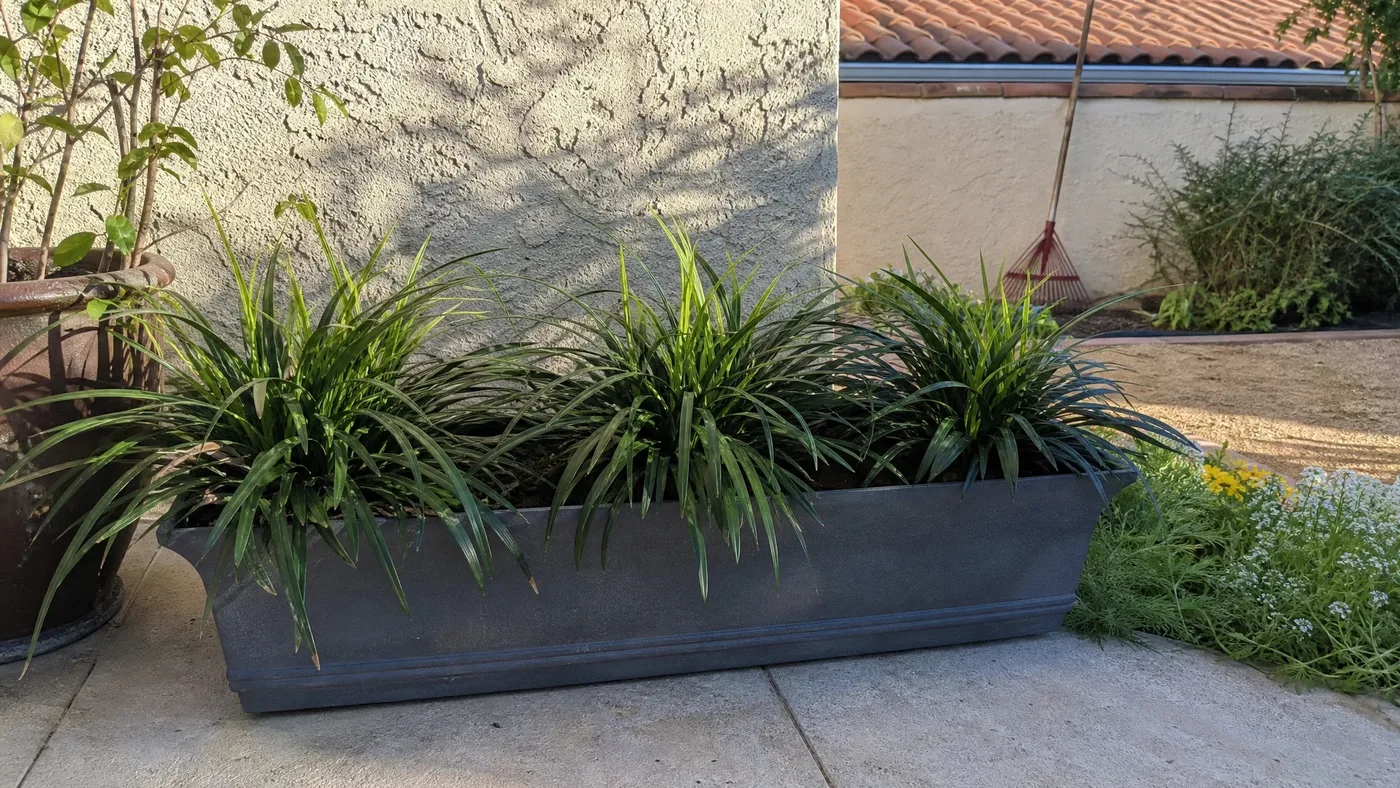
Growing Big Blue Lilyturf in Containers and Pots
One 24-inch trough, three clumps, and the measurements this guide follows from empty pot to first winter. People expect a pot to be a holding pen for a plant that wants to run. Big Blue does not run. It forms a dense, tight clump and stays where you put it, which is why it works in a container and its spreading cousin does not.
Pot culture still changes the rules. Roots sit in a small volume of mix, they dry faster than ground soil, and in cold weather they have no earth around them. Get those three wrong and you get rot in summer or dead roots in January.
We'll walk you through the trough and its numbers, the pot size, the drainage holes and mix, the planting depth and the watering rhythm, then the winter protection and what the planting looks like after a year.
Our Example Is One 24-Inch Trough
Every number in this guide comes from one planting, so you can copy it or scale it. Here is the setup.
| Item | Number | Why |
|---|---|---|
| Trough, inside size | 24 by 8 by 8 inches | Long and shallow suits a row of clumps |
| Mix volume | About 6 gallons | Filled to 7 inches deep |
| Plants | 3 clumps | One every 8 inches |
| Drainage holes | 3, each 1/2 inch | One per clump |
| Mix | 2 parts potting mix, 1 part bark fines, 1 part coarse sand | Moist but never soggy |
| Winter step | Wrap and 2 inches of mulch | Stands in for ground soil |
Why Big Blue Suits a Pot
Lilyturf works well in containers, and the reason is habit. Big Blue grows in a clump and has less tendency to spread by stolons. Liriope spicata spreads by rhizomes and will fill a trough with runners, then push out of it. We compare the two in Big Blue Lilyturf vs Liriope Spicata.
Keep It Outdoors
One of the most common questions we get is whether lilyturf can live indoors. The sources we rely on describe it as a landscape plant for sun to shade outside, and none of them recommend it as a houseplant. Treat the trough as an outdoor planter and put it on a porch, patio or step.
Sizing the Pot for a Big Blue Lilyturf Clump
Size the pot from the mature clump, not from the pot the plant came in. Clemson says the clump spreads to about 12 to 18 inches wide, and it grows the same 12 to 18 inches tall.
Do the Width Math
Three clumps at full width would need 36 to 54 inches in a line. Our trough is 24. That is on purpose. A container planting is meant to look full in its first year, and a lilyturf clump tolerates crowding far better than a bare gap does. You trade a little future room for a finished look now.
For a single plant, the rule is simple. Use a pot at least 12 inches across, and 18 inches if you want it to carry on for years without dividing.
Do the Volume Math
Multiply inside length, width and depth. A 24 by 8 by 8 inch trough holds 1,536 cubic inches. One gallon is 231 cubic inches, so that is about 6.6 gallons. Fill to 7 inches deep and you use 1,344 cubic inches, or about 5.8 gallons. Buy 6.
The common advice is to jump up a couple of pot sizes so the plant has room to grow into. We don't. A deep, oversized pot holds wet mix below the roots for weeks, and Big Blue does not like wet feet. Eight inches of depth is enough for a clump this size. If you are choosing nursery containers first, our buying guide covers the pots plants ship in.
Drainage Holes and Mix, Measured Out
Drainage decides whether this planting lives. Liriope needs moist, well-drained soil, and root rot can occur in sites with poor drainage or overwatering. A pot is a poorly drained site unless you build it otherwise.
Drill the Holes
Drill three holes of 1/2 inch, one under each future clump, which puts them 8 inches apart along the base. If the trough already has one small hole, add two more. Then lift the trough 1 inch off the ground on pot feet or bricks so the holes never sit against a wet surface.
Skip the layer of gravel at the bottom. We fill with mix all the way down so roots use the whole 8 inches.
Mix the Soil by Ratio
Mix in parts, using the same scoop or bucket for each. For our 6 gallons that is 3 gallons of potting mix, 1.5 of bark fines and 1.5 of coarse sand.
| Part | Amount in the trough | Job |
|---|---|---|
| 2 parts potting mix | 3 gallons | Holds moisture and nutrients |
| 1 part pine bark fines | 1.5 gallons | Keeps air in the mix |
| 1 part coarse sand | 1.5 gallons | Speeds drainage, adds weight |
The plant does well in acid to neutral soil, so you do not need to adjust pH. Dampen the mix before it goes in. Dry bark and potting mix repel the first watering.
Planting Big Blue Lilyturf at the Right Depth
Planting takes about 15 minutes with the mix ready. Follow these steps in order.
- Fill the trough with 3 inches of damp mix.
- Slide each clump out of its nursery pot and loosen the outer roots with your fingers. If they circle the root ball, tease them free.
- Mark the positions 4, 12 and 20 inches from one end. That leaves 4 inches at each end and 8 inches between clumps.
- Set each clump so the crown, where leaves meet roots, sits level with the finished soil line.
- Backfill until the soil line is 1 inch below the rim, about 7 inches from the base. That gap holds water as it soaks in.
- Firm the mix with your hands and water slowly until it runs from all three holes.
Check the Crown
Planting too deep buries the crown and invites rot. Planting too high leaves roots exposed as the mix settles. After the first soak, mix always sinks a little. Top up to the 7-inch line and recheck in a week.
Choose the Spot
Big Blue takes full sun to full shade, and flowers form most freely in sun. For a trough, we pick a spot with morning sun and afternoon relief, because the small mix volume heats and dries fast. In the ground, Big Blue gets more room per clump than this tight container layout.
Watering a Container of Big Blue Lilyturf
A pot dries far faster than a bed, so watering is the main job. The water need is low to moderate, which means you water on a check, not on a calendar.
The Finger Test
Push a finger 1 inch into the mix. If it is damp, wait. If it is dry, water. Pour about half a gallon slowly, in two passes, until water drips from all three holes. Then stop. Do not let the trough sit in a saucer of runoff.
The Rhythm by Period
Weeks 1 to 4: check every 2 days. New roots have not reached the walls yet, and the mix can swing from wet to dry quickly.
Summer: expect to water every 3 to 4 days in heat, and sooner in full sun or wind. Check after a stretch of hot days.
Spring and fall: about once a week, less after rain.
Winter: water only if the top 2 inches are dry, which in cold weather may mean once every few weeks. Evergreen leaves still lose water.
Feeding
Lilyturf is a light feeder that benefits from a slow-release or organic fertilizer in early spring. One application a year is plenty. Watering flushes nutrients out of a pot over time, so that spring feeding matters more here than in the ground. See our fertilizing guide for the rates.
Winter Protection Without Ground Soil
Winter is where container plants fail. The species is hardy in zones 5a through 10b, but those zones assume roots buried in earth. In a trough, cold reaches the roots from the sides and the bottom. In the colder part of that range, the pot needs help the in-ground form does not.
The Steps We Use
Do these in late fall, before the ground freezes hard.
- Move the trough against a house wall or other shelter. The plant needs shelter from cold winds and frost-prone areas.
- Keep the feet in place so water can drain out of the holes.
- Wrap the sides in burlap or bubble wrap, one layer thick.
- Spread 2 inches of shredded bark mulch over the soil, keeping it off the crowns.
- Water once if the mix is dry, so roots go into winter moist but not soggy.
What to Leave Alone
Do not cut the leaves in fall. They protect the crown. Prune before spring growth begins, so wait until late winter. Our winter care guide goes deeper on cold climates.
In the warmer end of the range, the wrap is optional. The mulch and the sheltered spot still cost nothing. For your exact cold-hardiness in a pot, check with your local extension service, since they know your winter lows.
Big Blue Lilyturf Pot Results After Year One
By the end of the first growing season, the trough should look like one planting, not three. Here is what to expect and what to change.
What You Will See
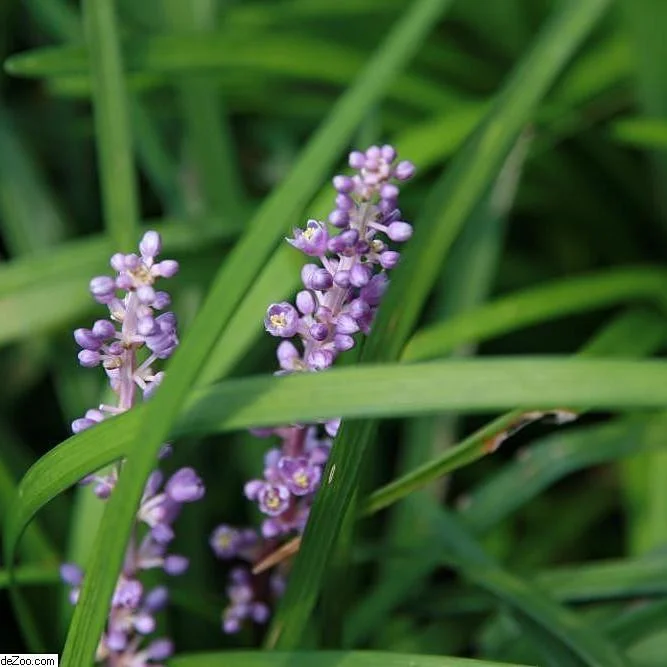
The foliage forms a dense clump of narrow, arching, dark green leaves, evergreen through the year. Big Blue stands 12 to 15 inches tall. Flower spikes of violet-purple appear in late summer into autumn. In our rows, container clumps flower a little later than ground-planted ones, so do not panic if spikes are slow.
What to Adjust
Drainage slows down. Roots have filled the mix. Check that all three holes are clear and lift the trough to look underneath.
The leaves yellow or brown. Look at your watering. Overwatering and poor drainage are the usual causes, so water less often before you change anything else.
The trough is packed. In late winter, before growth starts, divide the clumps. Our guide to dividing Big Blue shows how, and you get free plants for a second pot.
Refresh the top 2 inches of mix each spring and apply the slow-release feed. After that, leave it alone.
The Finished Trough in Four Numbers
Pot: a 24 by 8 by 8 inch trough, about 6 gallons of mix, with three 1/2-inch holes. Plants: three clumps, 8 inches apart, crowns level with a soil line 1 inch below the rim. Mix: 2 parts potting mix, 1 part bark fines, 1 part coarse sand. Winter step: shelter, one wrap and 2 inches of mulch.
Big Blue Lilyturf
Nursery-grown Big Blue Lilyturf in sizes from 1 GALLON, shipped to your door.
From $91.87
Shop Now →Water on the finger test, feed once in early spring and divide when the trough is full. As a small grower, we care about getting pots right because we grow and sell top-quality plants from our own farms, and a Big Blue that stays healthy in a trough is our best argument that this clumping lilyturf is easy once the drainage, depth and winter plan are in place.