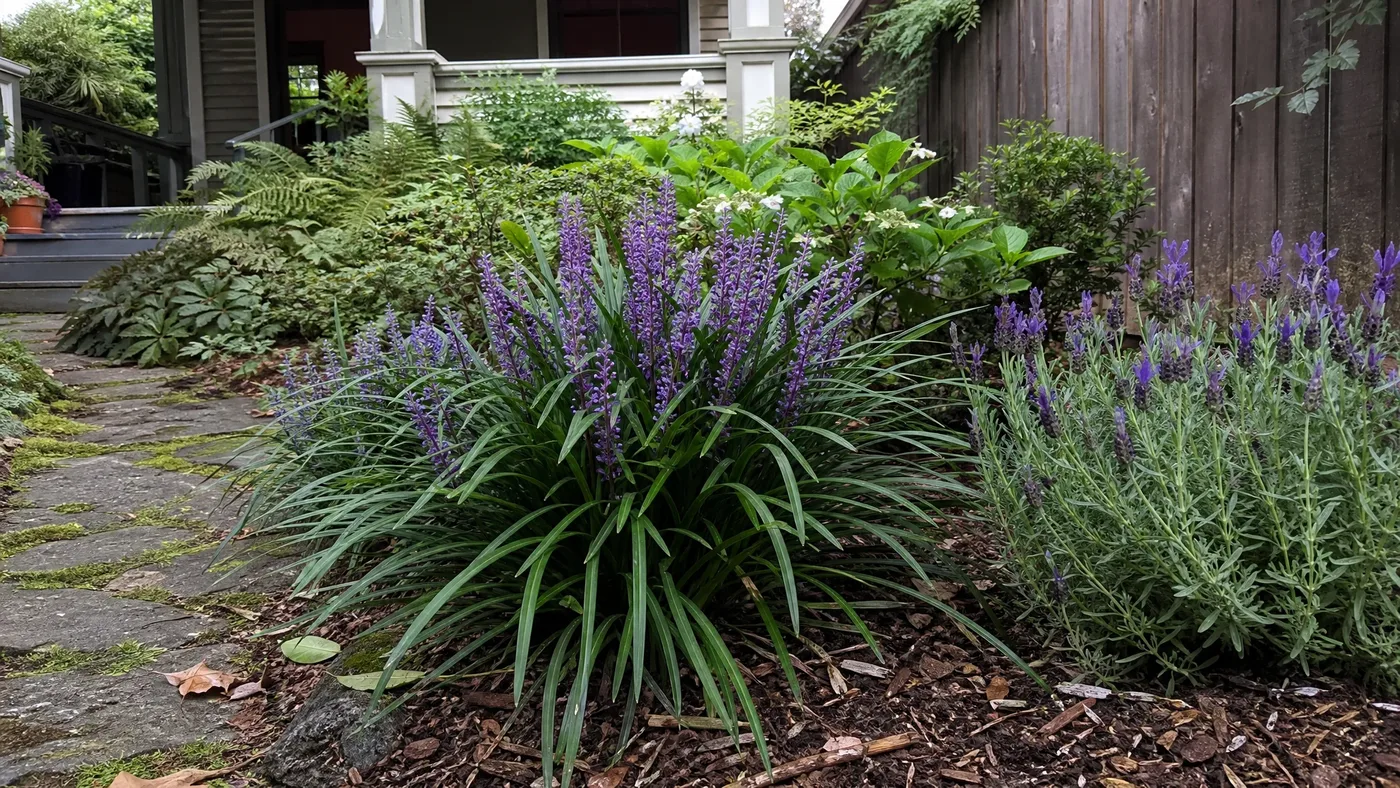
Big Blue Lilyturf vs Lavender: Sun, Soil and Care
Picture a gardener at the sunny edge of a path, a pot of lavender in one hand and a pot of Big Blue Lilyturf in the other. Both stay evergreen, both carry purple flower spikes, and both get sold as edging. The soil under their boots will decide the matter, and the light overhead has a vote too.
The two plants come from very different conditions. Lavender is native to the Mediterranean, a region of bright, dry summers and lean ground, and it still wants those conditions in your yard. Big Blue is a tuberous perennial that forms a dense clump of arching leaves, and it wants steady moisture that drains away. Put either one in the other's spot and it declines slowly or fails outright.
In this article, we'll go through sun, drainage, winter cold and upkeep, then looks and scent, and finish with a spot-by-spot match.
Decide How Much Sun the Spot Receives
Count the hours of direct sun before you look at a plant tag. Full sun means 6 or more hours of direct sunlight a day, and that is the number to check on your spot. Look at the bed at midmorning, noon and late afternoon on a clear day, because a place that is bright at noon is often shaded by three o'clock.
What Lavender Asks For
Lavender has one setting. English lavender requires full sun, and it pairs that with soil on the dry side. In part shade the plant turns sparse and leggy, and damp lingers around its crown. We would not plant it with less than a full day of open light.
What Big Blue Lilyturf Tolerates
Big Blue is far more flexible. Liriope grows in full sun, partial shade and deep shade. The limit is deep shade, where the plant will tolerate almost full shade but growth is slower and the leaves are elongated.
You will hear that lilyturf is a shade plant and nothing else. We disagree. Liriope flowers most freely in a sunny location, so a bright edge with decent moisture gives you more blooms than a dim corner. Our sun requirements guide goes deeper on reading your light.
The choice: Full sun with dry, lean soil points to lavender. Part shade, dappled light under trees and the shadow side of a house point to Big Blue. Deep shade belongs to Big Blue alone, with a slower and looser clump. Full sun with ordinary garden soil is a tie that the next decision breaks.
Check Whether Soil Drains or Holds Water
Most lavender losses start below ground. Roots take oxygen from the air pockets between soil particles. When soil stays saturated, those pockets fill with water, the roots suffocate, and rot organisms move into the weakened tissue. A plant that evolved in lean, quick-draining ground has little defense against that.
Test Before You Choose
Dig a hole where the plant will go, fill it with water and let it empty, then fill it again. If water is still standing the next day, the soil holds water. Also look at the spot after a heavy rain. "Well-drained" means water moves through and away after rain. It does not mean the soil is dry.
Why Lavender Fails in Clay
English lavender requires perfectly drained soil, preferably on the dry side. It also does not like wet feet and will die out in heavy clays. It prefers neutral to alkaline soil as well. If your ground is clay or stays damp, we advise against lavender in the open bed. A raised, gritty mound is the only workaround we trust.
Why Big Blue Lilyturf Is More Forgiving
Clemson says liriope requires moist, well-drained soil. It grows in acid soil below pH 6.0 and in neutral soil from 6.0 to 8.0. That range covers most garden soils.
Wet is still the limit, though. Clemson describes a leaf and crown rot caused by Phytophthora palmivora, a water mold, so standing water hurts Big Blue too. Our soil guide for Big Blue Lilyturf covers how to amend a slow spot.
The choice: Fast-draining sand or gravel, especially if it leans alkaline, goes to lavender. Average to moist soil that still drains, including loam and clay that drains, goes to Big Blue. Standing water after rain means neither one. Fix the drainage first.
Will Big Blue Lilyturf or Lavender Survive Your Winters?
Both plants hold their foliage through winter in mild climates, but cold treats them differently. NC State lists Big Blue Lilyturf for USDA zones 5a through 10b, a very wide span for a plant you set along a path and leave alone.
Lavender is narrower. English lavender is only marginally hardy in zones 5 and 6, and we treat those zones as a gamble rather than a plan. Sources rarely separate cold injury from wet-soil injury. A lavender that dies over winter may have been killed by cold, by soggy ground, or by both. That is one more reason drainage sits so high on this list.
At the warm end, our sources give no firm ceiling for lavender, so ask your local extension service how it performs in zones 9 and 10. Big Blue is listed through zone 10b. Our hardiness zones guide covers where Big Blue grows best.
Customers in zone 6 usually ask us whether lavender will come back after a hard winter. Our honest answer is that it might, and that Big Blue is the safer bet.
The choice: Zones 5 and 6 go to Big Blue. In warmer zones both are possible, and sun and soil make the call, with your extension service deciding the hottest zones.
What Big Blue Lilyturf Needs Once It Is Planted
Very little. The routine is steady water through the first year, then one trim a year. Lavender asks for more, and the difference shows up in three places.
Watering
Big Blue needs regular watering in its first year to keep soil moist. Once established, it needs very little supplemental irrigation. We send Big Blue Lilyturf out as rooted plants, so that first year is about keeping a working root system moist.
Established lavender wants even less. It prefers its soil on the dry side, so the usual error is too much water, not too little.
The Yearly Trim
Prune liriope before spring growth begins. For Big Blue that means one pass, and our guide to cutting back Big Blue Lilyturf shows how.
Lavender is a shrub, so cut it back yearly and remove the spent flower spikes after the flowers fade. Skip that and the stems turn woody and the plant opens up. We tell customers not to cut into leafless old wood, since it may not resprout. Cut into the leafy growth only.
Pests and Problems
Big Blue is deer and rabbit resistant. Liriope in general can suffer from anthracnose, with reddish-brown spots along leaf margins and tips, and from liriope scale. Both are worth knowing about, and neither is routine.
The choice: Big Blue is the lower-work plant. One trim, one tough first year, and then you can mostly leave it alone. Choose lavender only if you will prune it every year.
Weighing Big Blue Lilyturf and Lavender on Looks and Scent
If drainage and light allow both plants, this is the real decision. They look and behave nothing alike, even though both carry purple flowers.
Shape and Foliage
Big Blue is an evergreen clump of narrow, arching, leathery, dark green leaves. It reaches 1 to 1.5 feet tall and wide, and makes an attractive edging plant for walkways and paths. The line stays neat and low, with no stems to prune.
English lavender is a dwarf, broadly mounded shrub that grows up to 2 feet tall and 3 feet wide, and it is also evergreen. It spills over a path edge more than it lines one. Give it room.
Flowers and Fragrance
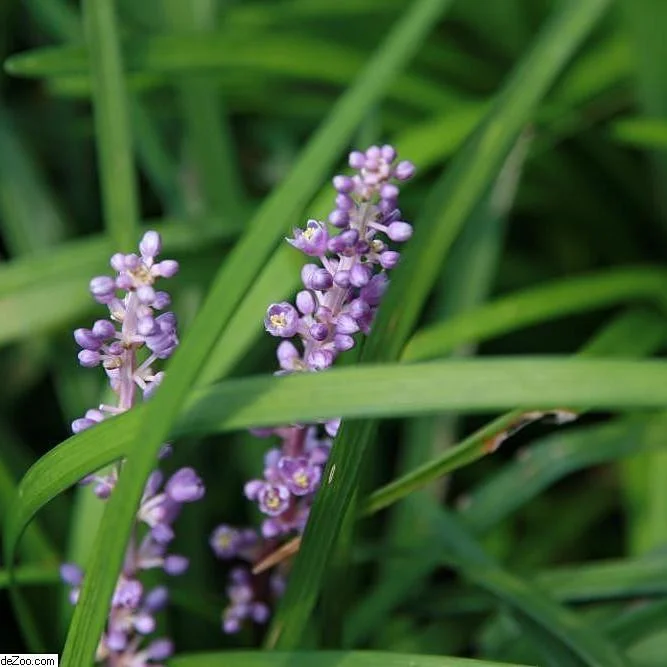
Big Blue's flowers are violet-purple spikes. The July to August window and the colors of lavender, purple, pink or white describe the species. Big Blue is the violet-purple one. The color name "Purple/Lavender" is only a color, so do not mistake it for the plant.
Lavender is the plant to choose for fragrance. We have no source describing a scent for Big Blue, and we do not sell it for that. If you want something to brush past on a walk, that is lavender's job.
The choice: Fragrance and a soft, mounded shrub point to lavender. A tidy evergreen line with late-season color points to Big Blue.
Matching Big Blue Lilyturf or Lavender to the Spot
Here are the earlier decisions applied to common situations along a path or border.
| Your spot | Better choice | Why |
|---|---|---|
| Full sun, sandy or gravelly, dry | Lavender | It wants perfectly drained soil on the dry side |
| Full sun, ordinary soil that stays a little moist | Big Blue | Lavender risks wet feet |
| Part shade or dappled light | Big Blue | Lavender needs full sun |
| Deep shade | Big Blue | Slower, with elongated leaves |
| Heavy clay | Big Blue, if it drains | Lavender dies out in heavy clay |
| Zones 5 and 6 | Big Blue | Lavender is marginal there |
| Path edge you want to brush past | Lavender | It is the fragrant one, if sun and drainage allow |
You do not have to pick one for the whole border. A path that runs from open sun into the shade of a tree can carry lavender in the bright stretch and Big Blue in the dim one. Size them differently. Lavender spreads up to 3 feet wide, while Big Blue forms a 1 to 1.5 foot clump, and our spacing guide covers planting it as an edge.
Our candid view is that most yards suit Big Blue. Lavender wins only where all three conditions line up: full sun, lean drainage and a zone it can survive. If you cannot say yes to all three, we would plant Big Blue and not fight the site.
The Order We Would Decide In
Start with light. Full sun with lean soil can go either way, but part and deep shade go to Big Blue. Next, drainage: fast, dry and gritty ground suits lavender, while average to moist soil that drains suits Big Blue. Then winter: zones 5 and 6 go to Big Blue. For upkeep, Big Blue is the lower-work option. Last, looks: fragrance and a mounded shrub point to lavender, and a neat evergreen edge with late color points to Big Blue.
Big Blue Lilyturf
Nursery-grown Big Blue Lilyturf in sizes from 1 GALLON, shipped to your door.
From $91.87
Shop Now →Before a plant leaves us, our growers check the root ball and the foliage, because those two things decide how a plant handles the drainage and watering we have covered here. As a small business with our own farms, we grow and sell top-quality plants, and we would rather you plant the right one for your spot.