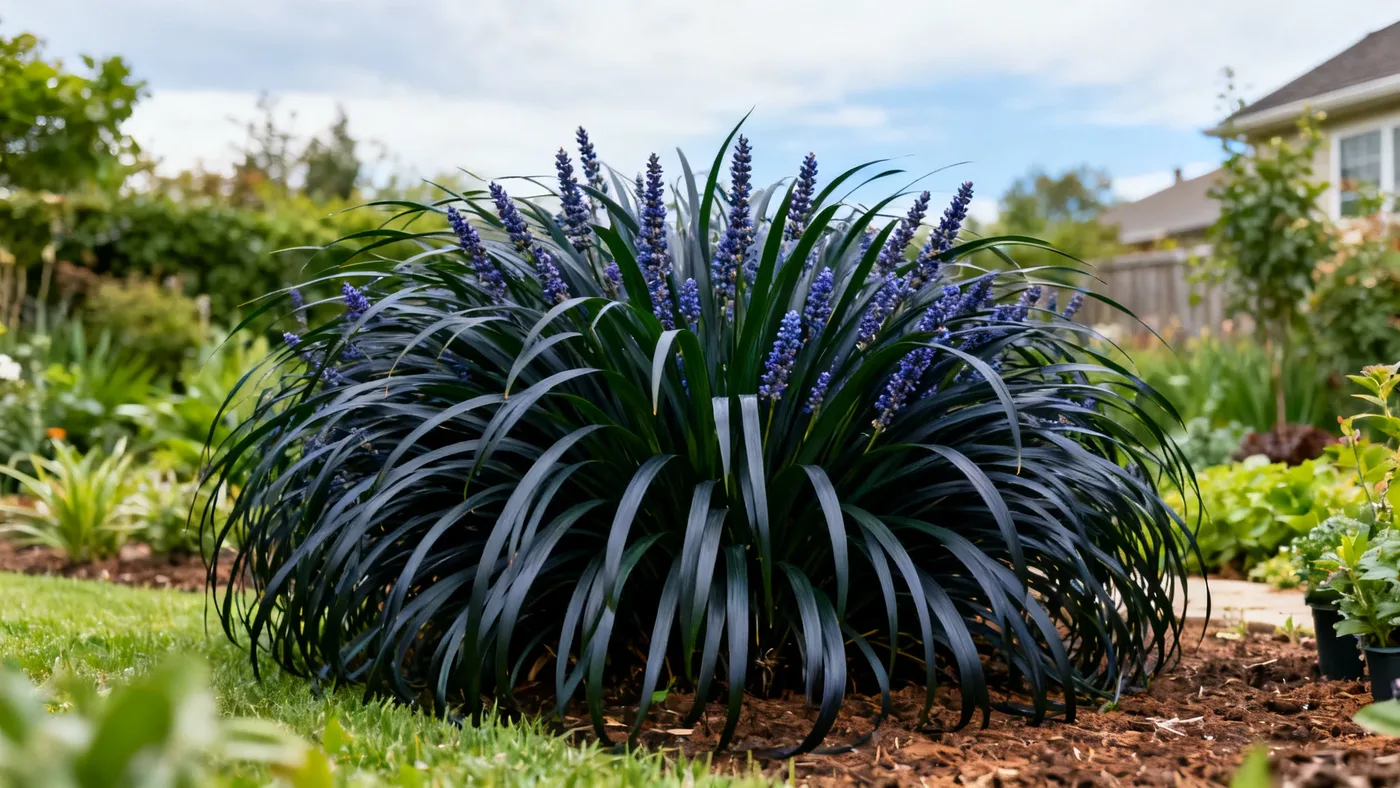
Best Soil for Big Blue Lilyturf: Drainage, Type and pH
Big Blue Lilyturf (Liriope muscari 'Big Blue') is one of the easiest ornamental groundcovers to grow, and that starts with understanding its soil preferences. While Liriope is adaptable and tolerates average garden soil, getting the basics right means the difference between a clump that merely survives and one that forms dense, vigorous growth with reliable purple flower spikes each summer.
The good news: you do not need perfect, expensive soil. Big Blue Lilyturf thrives in well-drained, average soil with a pH near neutral. What matters most is drainage and a soil texture that supports root establishment. Here's how to prepare the right foundation for your plants.
What You'll Need
Before you start, gather these materials (quantity depends on how many plants you are installing):
- Soil test kit (local extension service offers inexpensive or free kits)
- Compost or aged bark (2 to 3 cubic yards per 100 square feet of bed)
- Coarse sand (if your soil is clay-heavy)
- Garden lime or sulfur (only if test results indicate pH adjustment needed)
- A spade or garden fork
- A rake
- Measuring tape or ruler
- Gloves
Understanding Big Blue Lilyturf Soil Requirements
Liriope muscari is remarkably forgiving, adapting to clay, loam, or sandy soil. However, it has one non-negotiable demand: drainage. Standing water kills the roots and crowns, inviting root rot and crown rot. Poor drainage is the most common reason Big Blue Lilyturf fails to thrive or disappears altogether.
Your soil should feel moist after rain but dry to the touch within 24 to 48 hours. If water pools on the surface or soggy soil persists for days, drainage is the first problem to solve before planting.
Soil pH should fall between 6.0 and 7.0, which is slightly acidic to neutral. Most garden soils naturally sit in this range. A quick soil test costs very little and removes the guesswork. Contact your local extension service for testing kits and interpretation.
Step-by-Step Soil Preparation
Step 1: Test Your Soil
Submit a soil sample to your local extension service or use a home testing kit. You need to know the texture (sand, silt, clay composition), pH, and organic matter content. The test report will tell you whether your soil drains well and what amendments it needs.
If you cannot test (time or budget constraints), assume your soil benefits from added organic matter and plan to amend as described in steps 2 and 3.
Step 2: Amend Heavy Clay Soil
If your soil is predominantly clay or drainage testing shows poor permeability, work in coarse sand and compost. Clay on its own compacts and holds water; adding coarse material opens up pore space.
Dig out the top 8 to 12 inches of soil across your planting bed. Mix the excavated clay soil with equal parts (by volume) of coarse sand and compost. Spread this amended mixture back into the bed and work it in with a spade to create a loose, friable texture. The finished bed should feel crumbly and light, not dense and sticky.
For large beds, consider building a raised bed 6 to 8 inches high. This ensures drainage even if native soil below is poor.
Step 3: Amend Average Loam or Sandy Soil
If your soil drains well but lacks organic matter, loosen the top 6 to 8 inches and work in 2 to 3 inches of compost or aged bark mulch. This improves water retention and gives young Liriope clumps something to establish into.
You do not need heavy amendment; Big Blue Lilyturf is not a heavy feeder. A thin layer of compost improves structure without overloading nutrients.
Step 4: Check and Adjust pH (If Needed)
Test results that show pH below 6.0 warrant adding garden lime to raise it. If pH is above 7.5, add elemental sulfur to lower it. Follow the application rates on your product labels or your extension service's recommendations; adjustments take time and overshooting wastes money.
If your test result falls between 6.0 and 7.0, skip this step. Big Blue Lilyturf is adaptable within this range and does not need correction.
Step 5: Rake and Level
After amendment, rake the bed smooth and level. Remove any rocks larger than an inch, debris, and old roots. The surface should be firm but not compacted. Press down lightly with your boot; your footprint should compress a quarter-inch and spring back slightly.
Step 6: Plant and Mulch
Plant Big Blue Lilyturf clumps 12 to 18 inches apart, spacing them according to your design intent. The top of the root ball should sit level with the soil surface; buried crowns invite rot.
After planting, spread 1 to 2 inches of compost or aged bark mulch around the base of each clump, keeping it 2 inches away from the crown. Mulch moderates soil temperature and holds moisture during establishment. Avoid piling mulch against the foliage.
Drainage in Problem Sites
If you are planting on a slope or in a low-lying area prone to standing water, take extra steps:
- Slopes: Plant perpendicular to the slope so water runs past the clumps, not into them.
- Low spots: Mound soil 2 to 3 inches above grade to lift crowns above pooling water.
- Severe drainage: Install a French drain or perforated pipe at the lowest point of the bed, pitched toward a storm drain or daylight outlet. This is the only reliable fix if your soil is truly waterlogged.
Tips and Common Mistakes to Avoid
Do not bury the crown. The crown is the growing point where foliage and roots meet. Soil piled over it blocks air circulation and invites crown rot. Plant at the same depth it was in its container.
Do not plant in summer heat. Spring or fall is ideal for Liriope. Planting in June, July, or August stresses young clumps during peak heat and water demand. Wait for cooler, moister months.
Do not assume clay soil will not work. Clay is workable if you amend it. A 50/50 mix of clay with compost and sand is better than trying to replace it entirely, which is expensive and wasteful.
Do not skip mulch, but do not overdo it. A thin 1 to 2 inch layer improves soil health. A mulch volcano piled 4 to 6 inches high against the crown creates moisture retention that invites rot.
Do not add fertilizer at planting. Big Blue Lilyturf tolerates lean soil. A light spring feeding is enough; planting with rich fertilizer can accelerate salt burn and root problems in young plants.
Expected Results After Planting
Well-prepared soil should show results within weeks. Young Liriope clumps planted in spring or fall typically produce new growth within 2 to 4 weeks as roots establish. The first full growing season after planting (technically, the establishment period) usually spans roughly 1 growing season; during this time, water regularly if rain does not fall (about 1 inch per week is a reasonable guide).
By the second growing season, clumps may bloom if planted in spring and if days lengthen into mid to late summer (July-August in most regions). Established plants (after about 2-3 years) form dense, vigorous clumps and need little water beyond natural rainfall, even in the heat of summer, thanks to their high drought tolerance once roots deepen.
In zones 7-10, foliage remains evergreen year-round. In zones 5-6, foliage may brown or die back in harsh winters, but the crown survives underground and regrows in spring. Good drainage reduces winter damage and spring rot problems in colder zones.
Soil Maintenance in Established Plantings
Once plants are established, soil maintenance is minimal. A light application of general-purpose fertilizer in early spring supports growth. As mulch decomposes (typically over 2 to 3 years), refresh it with another thin layer. Do not let thatch or dead foliage build up against crowns; prune or mow old foliage to a few inches in late winter/early spring before new growth emerges.
For more detailed care practices after planting, see our Big Blue Lilyturf care guide, which covers sun exposure, watering, pruning, and seasonal management.
Quick Reference: Soil Preparation Checklist
| Soil Condition | What to Do | Key Depth/Amount |
|---|---|---|
| Heavy clay or poor drainage | Amend with sand and compost | Dig 8-12 in. deep; add equal parts sand and compost |
| Average loam with some organic matter | Light compost layer | Work in 2-3 in. of compost in top 6 in. |
| Sandy, drains too fast | Add compost for water retention | Work in 2-3 in. of compost |
| pH below 6.0 (too acidic) | Apply garden lime | Follow test kit or extension service rates |
| pH above 7.5 (too alkaline) | Apply sulfur | Follow product rates; adjustments are slow |
| Slopes or low-lying spots | Mound soil or install French drain | 2-3 in. mound or perforated drainage pipe |
| All sites | Apply mulch after planting | 1-2 in. compost or aged bark, keep 2 in. from crown |
| Spacing for borders/mass plantings | Set clumps at even intervals | 12-18 in. apart |