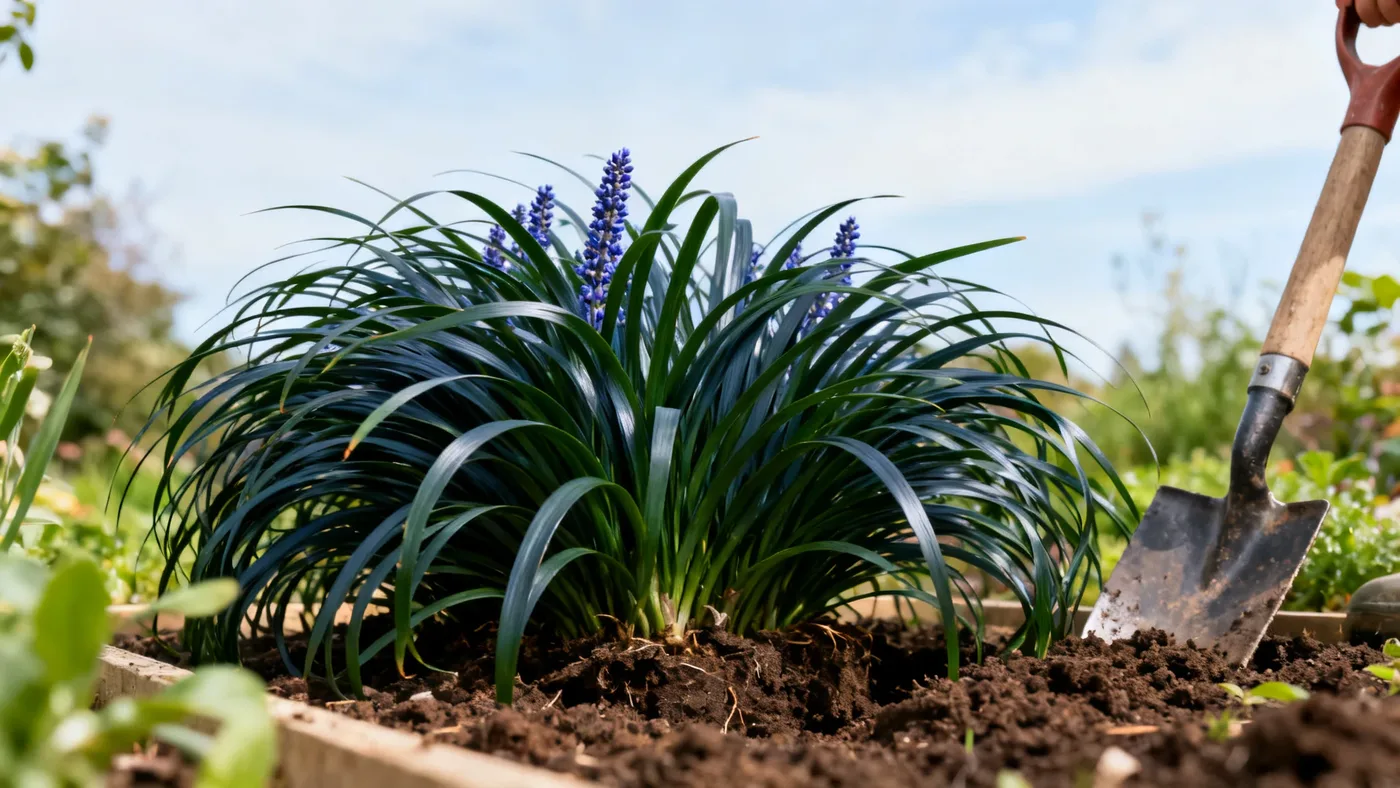
Big Blue Lilyturf Spacing for Borders, Edging and Mass Planting
Getting spacing right is one of the most important decisions you'll make when planting Big Blue Lilyturf. Too close together and the clumps compete for water and nutrients, crowding each other out. Too far apart and you'll wait longer for full coverage, with gaps showing bare soil. This guide walks you through the spacing guidelines that work for borders, edging, ground cover and mass plantings, plus the exact steps to lay out and plant your lilyturf the right way.
Understanding Big Blue Lilyturf's Growth Pattern
Big Blue Lilyturf (Liriope muscari 'Big Blue') is a slow to moderate grower. Each clump spreads a few inches per year via short rhizomes, naturally forming dense mounds about 12 to 18 inches wide at maturity. The foliage itself reaches 12 to 18 inches tall, with violet-purple bloom spikes rising slightly above that, around 18 to 24 inches in peak bloom.
This growth habit is why spacing matters so much. Plant too close and you'll have a solid wall of lilyturf in just a year or two, but with weak, spindly growth as the clumps fight for resources. Plant at the right distance and you get healthy, full clumps that fill in gradually without wasted energy on competition.
Spacing Guidelines for Different Landscape Uses
Big Blue Lilyturf Spacing for Borders
For borders along walkways, driveways or flower beds, plant Big Blue Lilyturf 12 to 18 inches apart. Most gardeners choose 12 inches (one foot) for borders where they want a quick, tight edge within one to two growing seasons. The clumps will be touching or nearly touching within 18 to 24 months, creating a solid, finished look.
If you have a long border and budget is tight, you can space at 18 inches to use fewer plants. The border will take an extra year or so to fill in completely, but you'll spend less upfront. The trade-off is visible gaps in year one and part of year two.
Big Blue Lilyturf for Edging Around Trees and Shrubs
Tree wells and shrub edging benefit from 12 to 15 inch spacing. The smaller spacing prevents adventurous lawn grass or weeds from creeping in while your lilyturf is still filling gaps. Once the clumps mature and touch, they form a living barrier that outcompetes weeds naturally.
Big Blue Lilyturf Mass Planting and Ground Cover
For larger mass plantings, liriope muscari border spacing can go to 18 inches (12 to 18 inches is the standard range). At 18 inches, you're using fewer plants per square foot, which lowers installation cost and reduces the workload during planting. Full coverage takes about 2 to 3 years instead of 18 months, but many gardeners find the savings worth the wait.
The key is knowing your site. Mass plantings under trees, in slopes or in shade gardens are ideal for the 18-inch spacing, since lilyturf thrives in shade and isn't rushed to fill in quickly. How far apart to plant liriope big blue in these situations depends on whether you need immediate fullness (choose 12 inches) or are willing to wait for a more gradual, natural effect (choose 18 inches).
Container and Mixed Plantings
Big Blue Lilyturf works as an edger in mixed containers and as a specimen in larger pots. For containers, plant lilyturf toward the edge 6 to 8 inches from the pot rim, spacing multiple clumps 8 to 10 inches apart in a large planter. One clump per container looks sparse at planting but fills a standard 12 to 18-inch pot nicely over one to two seasons.
Step-by-Step Planting Instructions
Materials You Will Need
- Big Blue Lilyturf plants (quart, #1 or #3 containers from a nursery)
- A measuring tape or ruler
- A spade or sharp shovel
- Compost or aged bark (optional, for soil amendment)
- Water source (hose or watering can)
- Work gloves
- A marking tool (chalk, string or spray paint) for layout
Steps for Spacing and Planting
Step 1: Measure and Mark Your Spacing Layout
Lay out your planting bed using a measuring tape. For a 12-inch spacing, mark every 12 inches along the border or mass planting area. Use chalk, stakes and string, or temporary spray paint to create a visual guide. Double-check your measurements before digging. It's much easier to adjust marks than to move planted lilyturf later.
Step 2: Prepare the Soil
Clear the area of weeds, grass and debris. You don't need to dig deep. Big Blue Lilyturf is adaptable to average, well-drained soil and tolerates clay. If your soil is heavy clay or compacted, loosen the top 6 to 8 inches with a spade and work in 2 to 3 inches of compost. This isn't required, but it speeds establishment and reduces the time to your first full growing season.
Step 3: Dig Planting Holes
Dig holes slightly wider and the same depth as the root ball of your lilyturf plant. For most nursery quart or #1 containers, holes are 6 to 8 inches wide and 4 to 6 inches deep. Space holes according to your marked layout.
Step 4: Position Each Plant
Remove the lilyturf from its container and gently loosen the root ball by hand or with a knife if roots are tightly wound. Plant at the same soil level as the container. Big Blue Lilyturf should not be buried deeper than it was growing in the pot, or the crown may rot.
Step 5: Backfill and Water Thoroughly
Fill holes with native soil, pressing gently to remove air pockets. Water each plant immediately after planting to settle soil and establish contact between roots and soil. Water the entire planting bed so soil is moist to a depth of 4 to 6 inches.
Step 6: Mulch (Optional but Helpful)
Spread 1 to 2 inches of aged bark or compost around each plant, leaving a 2-inch gap around the foliage crown to prevent rot. Mulch helps retain moisture during establishment and suppresses weeds as your lilyturf fills in.
Tips to Avoid Common Spacing Mistakes
Mistake 1: Planting Too Close
It's tempting to reduce spacing from 12 inches to 8 or 9 inches to get instant coverage. Resist this. Overcrowded lilyturf clumps starve for water and nutrients, leading to weak growth, disease susceptibility and a thin, straggly appearance by year two. Stick to 12 to 18 inches.
Mistake 2: Uneven Spacing
Eyeballing distances leads to some clumps 10 inches apart and others 16 inches apart. This creates a patchy, disjointed look as some fill in while others lag. A measuring tape takes five extra minutes and makes all the difference.
Mistake 3: Forgetting Your Mature Width
Each clump spreads to 12 to 18 inches wide at maturity. If you space at 12 inches and don't account for that spread, two mature clumps can overlap and compete. If overlap is what you want (for a denser effect), that's fine. But make the choice intentionally, not by accident.
Mistake 4: Inconsistent Watering During Establishment
Spacing at 18 inches requires patience and consistent water for the first growing season. If you underwater to save effort, clumps struggle, and coverage takes much longer. Water newly planted lilyturf weekly in the first month, then adjust based on rainfall and soil moisture.
Expected Results and Timeline
With 12-inch spacing, your border or mass planting should look substantially filled in within 18 to 24 months. Individual clumps are still separate in year one, but gaps narrow visibly by late summer of year two.
At 18-inch spacing, expect noticeable coverage by year two and full, touching clumps by year three. This timeline assumes average rainfall or weekly watering in the first season.
For more details on long-term care after spacing and planting, see the Big Blue Lilyturf care guide: sun, soil, water and more. Big Blue Lilyturf is deer resistant, so you don't need to worry about wildlife pressure affecting your spacing plan or final appearance.
Quick Reference: Spacing by Landscape Use
| Landscape Use | Spacing | Plants per 10 ft | Fill-in Timeline | Best For |
|---|---|---|---|---|
| Tight border | 12 in. | 10 plants | 18-24 months | Walkways, defined edges |
| Loose border | 15 in. | 8 plants | 24-30 months | Budget-conscious borders |
| Mass planting | 18 in. | 6-7 plants | 24-36 months | Slopes, shade, larger areas |
| Under trees | 12-15 in. | 8-10 plants | 18-24 months | Weed suppression |
| Containers | 8-10 in. | 2-3 per pot | 12-18 months | Mixed plantings |